SENTA 2019 Discusses Sustainable Innovation in the Maritime Sector
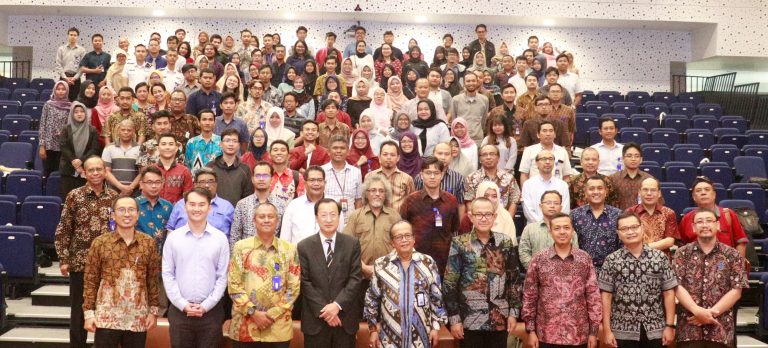
As a response to the technological developments caused by the Industrial Revolution 4.0, automation and digitalization in the maritime sector are increasingly rising. Responding to this, the Faculty of Marine Technology (FTK) at Institut Teknologi Sepuluh Nopember (ITS) once again held the National Seminar on Marine Technology and Application (SENTA) on Thursday (5/12) to discuss sustainable innovation for the development of Indonesia’s maritime sector.
Dr. Eng IGN Sumanta Buana ST MEng, Chairman of the SENTA 2019 Committee, mentioned that this annual event, which has reached its 19th year, has transformed into an international conference since 2016. According to him, after serving for 15 years as a forum for Indonesian researchers and engineers to exchange information, ideas, and research results to improve Indonesia’s maritime sector, this activity is ready to step up to an international scale.
“Therefore, starting in 2016, this event not only features Indonesian researchers but also researchers from abroad,” said the lecturer from the Department of Marine Transportation Engineering.
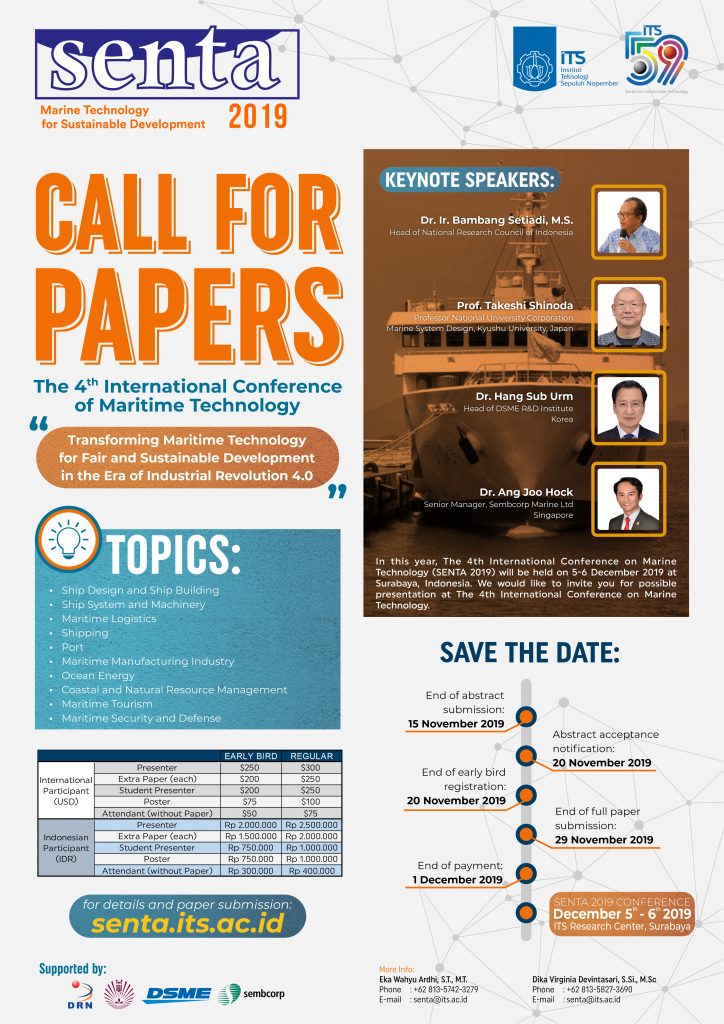
Adopting the theme Transforming Maritime Technology for Fair and Sustainable Development in the Era of Industrial Revolution 4.0, the event held at the ITS Research Center Building Auditorium focused on ten sub-themes of discussion. These included Ship Design and Construction, Marine Systems and Machinery, Maritime Logistics, Shipping, Ports, Maritime Manufacturing Industry, Ocean Energy, Coastal and Natural Resource Management, Marine Tourism, as well as Maritime Defense and Security.
Opening the seminar, Dr. Ir Bambang Setiadi IPU, Chairman of the National Research Council of Indonesia, stated that all types of technology will continue to be dynamic and undergo changes for the better. Considering that change always begins with an innovation, the man affectionately known as Bambang emphasized that innovating is very important. “Just like the concept of invention to innovation, which means that innovation is an invention that is commercialized,” he asserted.
Highlighting Indonesia’s innovation, which ranks 85th in the world in the Global Innovation Index, the man who earned his doctorate at Universitas Gadjah Mada stated that support from all parties is highly necessary. Keeping in mind that in Indonesia, there are many inventions and research waiting to be developed and commercialized.
In addition, Bambang also conveyed several opportunities for the development of maritime technology in the future. Starting from the development of shipping technology and autonomous shipping, the development of connected smart ports, as well as the digitalization and development of navigation and communication ecosystems. He also added the invention of motorized container barges and vegetable oil tanker ships currently being developed by the National Research Council.
Dr. Hang Sub Urm, Executive Vice President of Daewoo Shipbuilding & Marine Engineering (DSME) Research and Development Institute, South Korea, who was also present at the event, conveyed the focus of the maritime technology development they are currently campaigning for. Namely, decarbonization, digital transformation, and defense technology, which they combine into a concept called Current and Future Ship Technology.
According to him, with decarbonization, the issue of fuel use emissions can be resolved so that environmental sustainability is maintained. Furthermore, equally important is digital transformation in shipping technology to increase operational efficiency for ships and shipyards. “For example, a smart ship with an autonomous ship feature that allows the ship to run without being steered by a captain has begun to be developed,” he explained.
By paying attention to these two aspects, sustainable shipping technology will grow rapidly. Thus, it can also support national interests in maintaining energy resilience, national defense, and also to fulfill market needs in the energy sector. “Certainly, all of the above must be pursued and with the support of all parties,” he concluded. (yus/rur)
Official SENTA 2019 Poster