Discussing Food and Energy Sovereignty through SENTA 2018
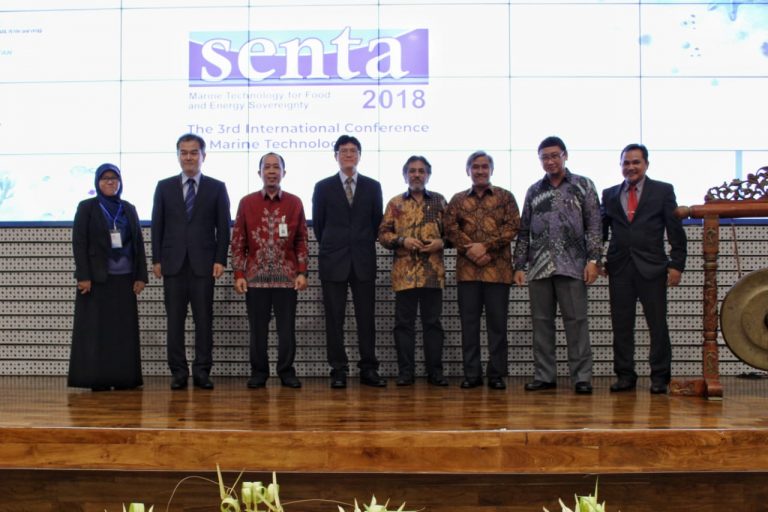
The maritime world for Indonesia represents a wealth of natural resources that must be optimally managed to meet its own needs in various fields, including food and energy. Discussing maritime technology for food and energy sovereignty, the Faculty of Marine Technology (FTK) at Institut Teknologi Sepuluh Nopember (ITS) held the National Seminar on Theory and Application of Technology (SENTA) at the Research Center Building, Wednesday (5/12).
This 18th annual seminar serves as a forum for researchers and engineers in maritime technology from both Indonesia and abroad. Starting as a national-scale seminar in 2001, SENTA expanded into an international-scale seminar in 2016, bringing in various competent international speakers.
Held over two days, SENTA 2018 presented five keynote speakers. The Head of the Marine Research and Human Resources Agency of the Ministry of Marine Affairs and Fisheries (KKP) Prof. Ir. R. Sjarief Widjaja, Ph.D., and the Director of Various New Energy and Renewable Energy of the Ministry of Energy and Mineral Resources (ESDM) Harris, S.T., M.T., served as speakers on the first day. Meanwhile, Prof. Ikegami Yasuyuki from the Institute of Ocean Energy Saga University, Prof. Kungyen Lee from Ocean Engineering of National Taiwan University, and the Secretary General of the Indonesian Academy of Sciences (AIPI) Dr. Chairil Abdini presented on the second day.
Nur Syahroni, Ph.D., the Organizing Chairman of SENTA 2018, explained that the theme was chosen because Indonesia’s potential in food and energy resources is massive. Proper management is required so that Indonesia does not continuously rely on other countries for food and energy supplies. “Efforts to increase food and energy sovereignty are made through the development of maritime technology that supports the utilization of natural resources owned by Indonesia,” explained the Head of the Marine Study Center at LPPM ITS.
Meanwhile, Director Harris explained that in the maritime sector, the government through the Directorate General of New, Renewable Energy and Energy Conservation (EBTKE) has made several efforts to develop ocean energy pilot projects. These include collaborative studies for ocean current power plants with the Agence Francaise de Development (AFD) from France and the Austrian Government. Domestically, the Ministry of ESDM and the Ministry of Public Works and Public Housing (PUPR) plan to develop an Ocean Current Power Plant integrated with the Pancasila Palmerah Bridge in the Larantuka Strait, featuring a capacity of 30 Mega Watts and an investment of approximately 215 million USD.
In the food and marine sectors, Prof. Sjarief Widjaja highlighted that the government has applied the latest technologies to support its programs. Fisheries data is updated daily via satellite to produce Fishing Ground Forecast Maps (PPDPI), which are utilized by traditional fishermen through the Laut Nusantara application. Furthermore, there is an integrated marine surveillance system utilizing the Wakatobi Radar to detect floating elements and foreign ships operating in Indonesian waters within a 55.5 km radius.