SENTA 2016 Discusses Challenges in the Maritime World
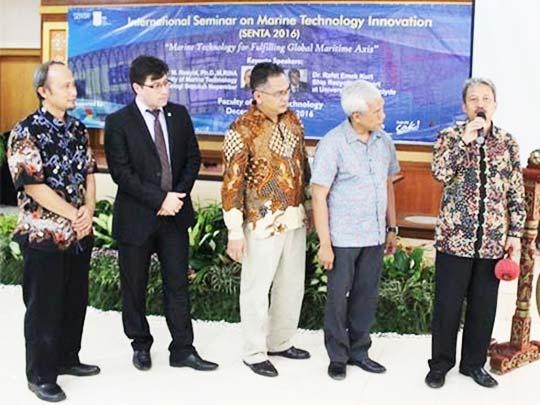
“Maritime technology graduates must dare to take risks in Eastern Indonesia,” said Daniel, Dean of the Faculty of Marine Technology (FTK), opening his remarks at SENTA 2016. The seminar, held in the BG Munaf seminar room, attracted the attention of national and international maritime experts.
Daniel stated that Indonesia currently does not have a strong maritime authority. In fact, as an archipelagic country where most of its territory is water, Indonesia should have a strong desire to prioritize the vision of a maritime axis.
According to Daniel, on one hand, there is a flawed mindset in society that centralizes production in the western region. “The eastern region, which is rich in natural resources, is left far behind,” he said.
Addressing this issue, Daniel challenged maritime education graduates to be brave enough to look at eastern Indonesia. Academic graduates, especially in the maritime field, have the potential to develop maritime infrastructure that could reduce the development gap in Eastern Indonesia.
On the other hand, people in the east also frequently reject the presence of outsiders in their area. However, the initial intention of these graduates is to build a more advanced maritime civilization. Nevertheless, the Klaten-born lecturer sees this problem as a prospective new opportunity in facing the tight competition in the workforce.
More complexly, in addition to mentioning local problems, the University of Newcastle Upon Tyne graduate also revealed international-level maritime competition. Besides Indonesia, there are also several foreign countries with a great desire to become the world’s maritime axis, such as China.
China is known to be persistent in intensifying its maritime silk road program. In 2015, China allocated 0.2 Trillion US Dollars for resilience in the maritime sector. This dramatic figure was also followed by America, which poured out 0.6 Trillion US Dollars for the utilization of the maritime sector.
Indonesia itself, Daniel said, has only dared to allocate 0.01 Trillion US Dollars, representing 0.9 of Indonesia’s Gross Domestic Product. “This contrasting difference concludes that Indonesia’s ambition is still far behind,” he concluded. (efa/ven)